Anti-Biofouling Membrane for Pressure-Retarded Osmosis
Evaluating membrane fouling and performance in PRO process
First Author
Fabrication, characterization (SEM, AFM, CLSM)
Yeji Kim, Eunmok Yang, Hosik Park, Heechul Choi
Jan 2018 – Jan 2019
Published: Kim, Y., Yang, E., Park, H., & Choi, H. (2020). RSC Advances, 10(10), 5697–5703. DOI →
Overview
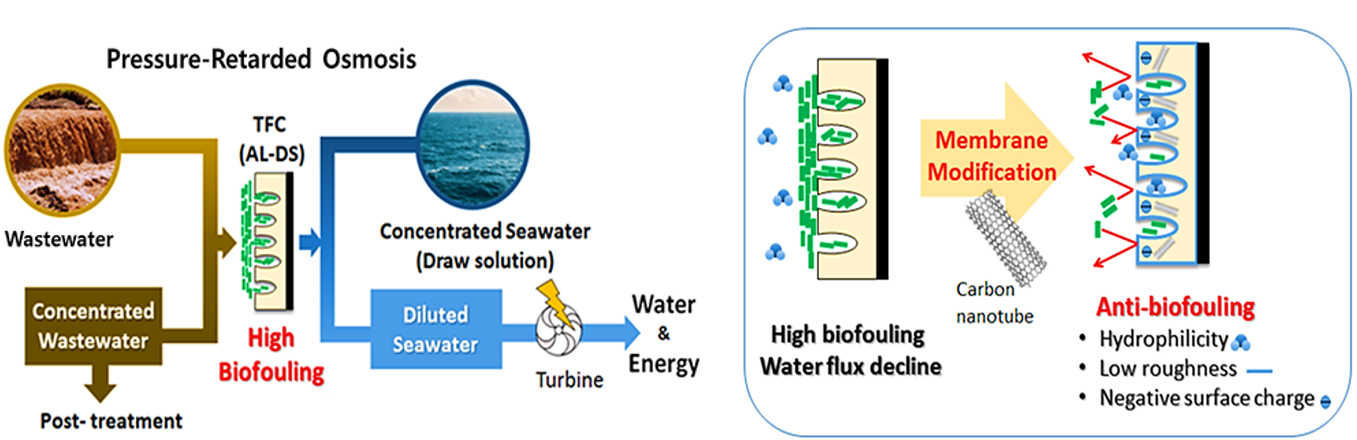
This work developed and evaluated a thin-film nanocomposite membrane with a functionalized-carbon-nanotube-blended support layer to mitigate biofouling in the pressure-retarded osmosis (PRO) process — a critical issue limiting long-term operation of osmotic membrane systems.
Approach
- Engineered the support-layer composition to control surface roughness, charge, and hydrophilicity
- Characterized membrane surface via SEM, FTIR, AFM, contact angle, and zeta potential measurements
- Tested membrane performance under cross-flow PRO mode (AL-DS) with bacterial attachment and biofouling assays
Key Findings
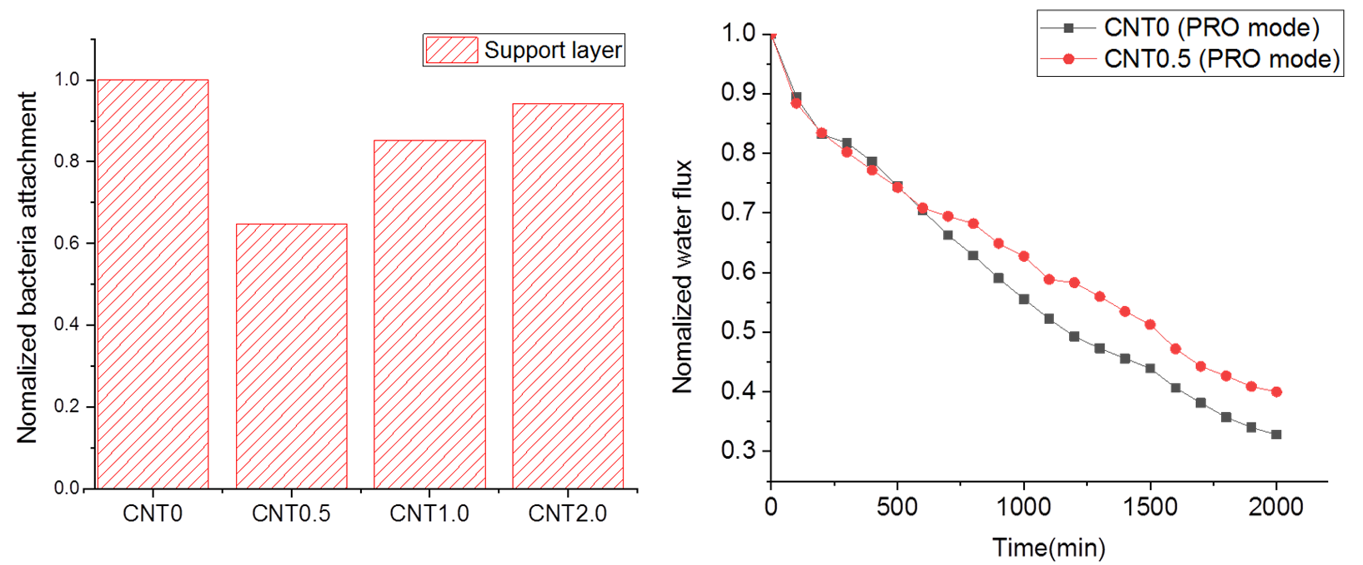
- ~35% reduction in bacterial attachment on the modified membrane vs. the bare TFC reference
- Only ~10% water flux loss during long-term biofouling testing in PRO mode
- Improvement attributed to lower surface roughness, higher negative surface charge, and increased hydrophilicity
Reference
Kim, Y., Yang, E., Park, H., & Choi, H. (2020). Anti-biofouling effect of a thin film nanocomposite membrane with a functionalized-carbon-nanotube-blended polymeric support for the pressure-retarded osmosis process. RSC Advances, 10(10), 5697–5703. https://doi.org/10.1039/C9RA08870A