Water Distribution System Digital twin
Deployment of Digital twin with Wireless Sensors for WaterDistribution Systems in Rural Alaska
First Author
Yeji Kim, Matthew Bartos
Jan 2024- Dec 2025
Design, Deployment, and Evaluation of Wireless Sensors for Monitoring WaterDistribution Systems in Rural Alaska
Abstract
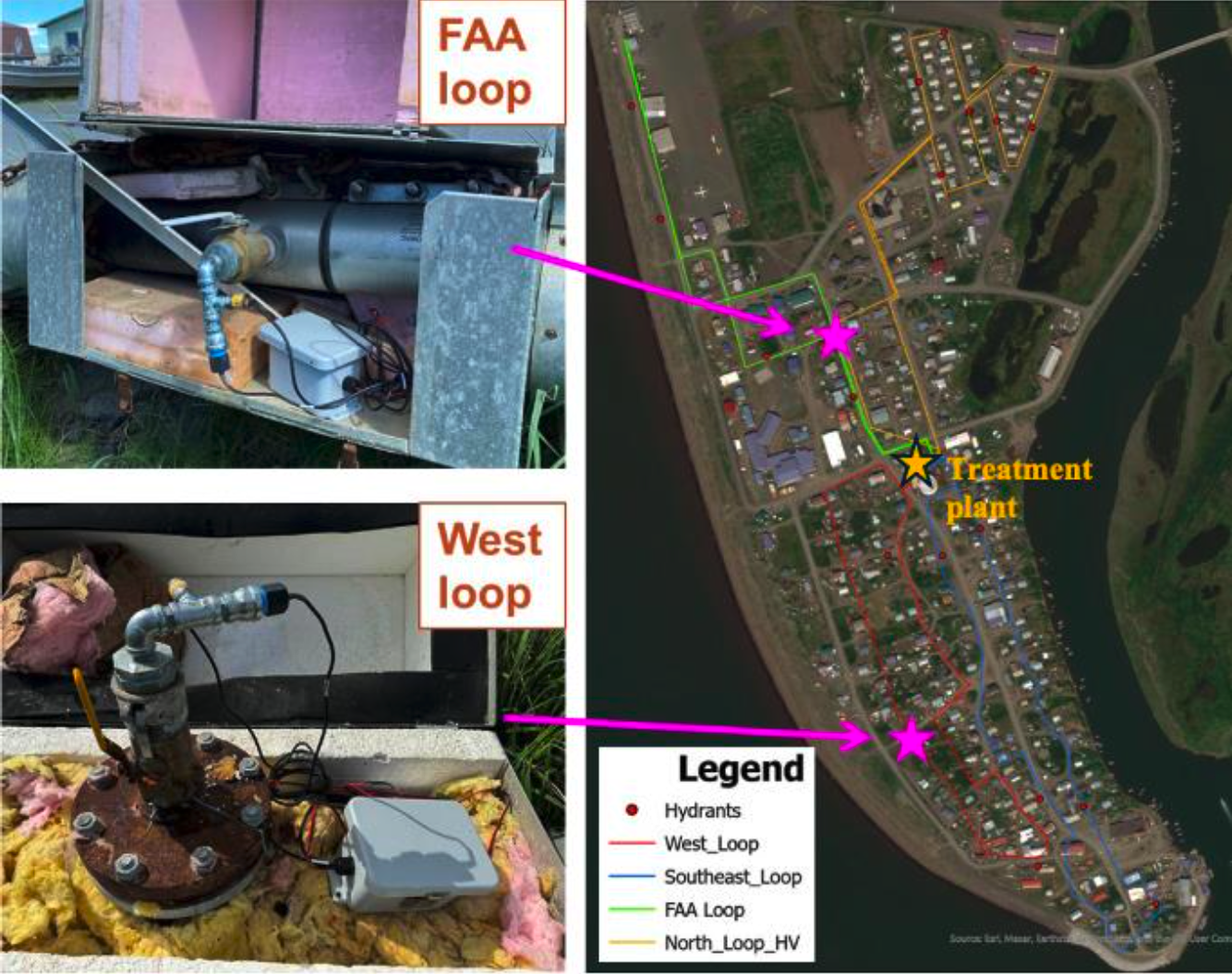
Continuous monitoring of water distribution systems has become a key practice for ensuringefficient operation and management. In particular, pressure monitoring plays a crucial role indetecting and localizing both ongoing and sudden leaks that lead to significant water losses.Monitoring such systems in Arctic regions is especially valuable, as frequent freeze–thaw cyclesincrease the risk of leaks and system failures. Monitoring water distribution systems in ruralAlaska, however, presents unique challenges due to harsh weather conditions and limitedcommunication infrastructure. This study focuses on the design, deployment, and evaluation ofwireless sensors for tracking water distribution system pressure and temperature in Unalakleet,Alaska. We first present the design of our sensor nodes, which incorporate low-power pressureand temperature sensors, solar panels for energy harvesting, and a microcontroller that transmitsdata to a cloud-hosted database in real time. Sensor nodes are deployed on hydrants located ontwo of four of the community’s water distribution loops. Using the collected dataset, we evaluatethe pressure sensors’ ability to detect diurnal pressure changes and assess how ambient airtemperature fluctuations affect water temperature at each hydrant at daily and monthly time-scales. Ultimately, this research aims to enhance the resilience and efficiency of waterdistribution systems in rural Alaska through continuous monitoring, with solutions that may beextended to similarly challenging environments.

A Digital Twin Framework for Rural Alaska Water Distribution Systems
(This study still on-going)